ZX Spectrum guide
ZX Spectrum Glossary: Terms From A to Z
The words Spectrum fans use, from attribute clash to Z80, explained in plain English with links to the guides that go deeper.
- 128K
- The Spectrum models with 128 KB of memory and an AY sound chip: the Spectrum 128, +2, +2A, +2B and +3. See 48K vs 128K.
- 48K
- The original Spectrum with 48 KB of memory, and the machine most classic games were written for.
- Assembly language
- Programming in the processor's own instructions, written as short words such as
LDandJP. Most commercial Spectrum games were written this way. - Attribute
- The byte that sets the ink, paper, BRIGHT and FLASH for one 8 × 8 cell of the screen. See attribute clash.
- Attribute clash
- When two differently coloured objects share an 8 × 8 cell and one takes on the other's colour. Also called colour clash.
- AY (AY-3-8912)
- The three-channel sound chip in the 128K models, used for music.
- BASIC
- The programming language built into every Spectrum, used for loaders, learning and simple games.
- Beeper
- The 48K's single-channel sound: a speaker switched on and off by the processor.
- Border
- The area around the main screen, which can be set to one colour and flickers with stripes while loading.
- BRIGHT
- An attribute setting that makes a cell's colours more vivid.
- Contention
- The way the Spectrum's display hardware briefly holds up the processor when both want the same memory. Accurate emulators reproduce it.
- Cursor joystick
- A joystick interface that acts like keys 5, 6, 7, 8 and 0. See joysticks.
- Datacorder
- Amstrad's name for the cassette deck built into the Spectrum +2.
- Emulator
- Software that imitates a computer, so its programs run on another device. See the best emulators.
- FLASH
- An attribute setting that makes a cell swap its ink and paper colours regularly.
- Flip-screen
- A game where the view jumps a whole screen at a time when you walk off the edge, rather than scrolling.
- FPGA
- A chip that can be configured to act as other hardware. The Spectrum Next uses one. See the Spectrum Next.
- Header
- The short tape block that gives the name, type and length of the block after it.
- Homebrew
- New games and programs written by enthusiasts for old computers, long after their commercial life.
- Ink and paper
- The foreground and background colours of an attribute cell.
- Interface 1 and 2
- Sinclair add-ons. Interface 1 added the Microdrive, networking and a serial port; Interface 2 added two joystick ports and a cartridge slot.
- Issue
- A revision of the Spectrum's circuit board, such as Issue 2 or Issue 3.
- Kempston
- The most widely supported joystick interface, read through its own input port.
- LOAD ""
- The command to load the next program from tape. See tape loading.
- Loading screen
- A picture that loads before the game, filling the screen line by line.
- Microdrive
- Sinclair's small, fast tape-loop storage device, used with Interface 1.
- Paging
- Switching which 16 KB bank of memory the processor can see, used by the 128K to reach its extra memory.
- Parser
- The part of a text adventure that understands what you type. See The Gullrock Light.
- Pilot tone
- The steady note at the start of each tape block that lets the Spectrum lock on to the signal.
- POKE
- A BASIC command that writes a number into memory. "POKEs" are also cheats, such as infinite lives.
- ROM
- The read-only memory holding the Spectrum's BASIC and tape routines.
- Sinclair joystick
- A joystick that acts like number keys (6 to 0 or 1 to 5), as on Interface 2 and the Amstrad models.
- Snapshot
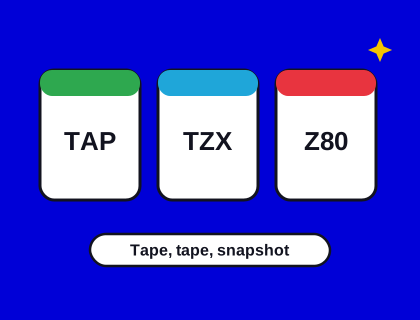
- A file holding the whole state of the machine at one moment, such as a Z80 or SNA file. See file formats.
- Speccy
- Fans' affectionate nickname for the ZX Spectrum, and the name of the emulator that runs our arcade.
- Sprite
- A moving graphic, such as the player's character.
- Symbol Shift
- The Spectrum's second shift key, used for punctuation and extra keywords.
- TAP
- A simple tape-image file holding the blocks of a tape that uses the standard loader.
- Turbo loader
- A custom tape loader that loads faster than the standard one, often with copy protection.
- TZX
- A tape-image file that can preserve custom loaders and exact timings.
- ULA
- The Spectrum's custom chip, which produces the display, reads the keyboard and handles the tape and sound signals.
- Z80
- The Zilog Z80A, the Spectrum's 8-bit processor, running at about 3.5 MHz.
Ready to try it out? Play a Spectrum game online or load your own tape.